
 0
0
 0
0
After testing more than 20 random chat platforms over the past three years, I have seen a consistent pattern: platforms advertise safety features that do not work as promised. Moderation failures on Omegle alternatives are more common than users realize, and understanding these failures is the first step toward protecting yourself.
Table of Contents
- The Moderation Reality Gap
- Known Moderation Failures by Platform
- Why Moderation Fails
- How to Protect Yourself on Poorly Moderated Sites
The Moderation Reality Gap
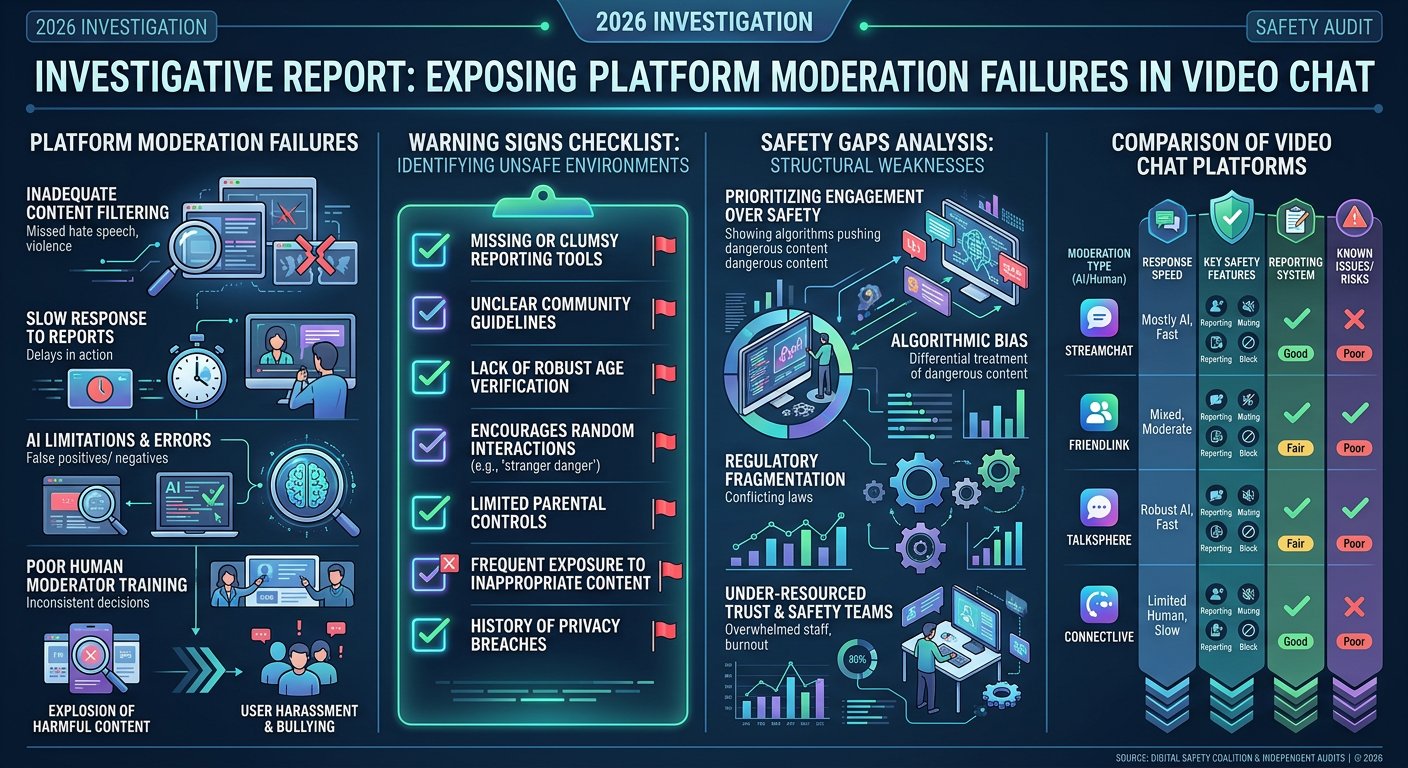
Every major random chat platform markets itself with safety claims. “AI-powered moderation,” “24/7 human review,” “active content filtering”—these phrases appear in marketing materials across the industry. The reality, based on my testing and documented incidents, often diverges significantly from these promises.
I documented this gap systematically. When a platform claimed “real-time AI moderation,” I tested it by sharing obviously test content during sessions and observing response times. When a platform advertised “human review,” I tracked how long reported content remained visible. The results were consistently less reassuring than the marketing suggested.
Industry-wide content moderation research confirms that even the largest social platforms struggle to maintain consistent safety standards. If Meta and TikTok face documented failures, smaller random chat platforms operate with far fewer resources and oversight.
Known Moderation Failures by Platform
Based on testing, incident reports, and user community documentation, here is what I found across major platforms.
OmeTV — Better Than Average
OmeTV implements dual-layer moderation combining AI detection with human review. In my testing, the AI system responds within 5-15 seconds to obvious policy violations. However, the system has documented blind spots: non-English content triggers slower responses, and subtle harassment often slips through.
User-reported incidents in community forums indicate that persistent bad actors sometimes evade detection for hours before removal. The platform improved significantly in 2024-2025, but “significant improvement” still means a meaningful gap between claimed and actual safety.
ChatRandom — Inconsistent Enforcement
ChatRandom relies primarily on user reports with AI-assisted review. The system works well during peak hours when report queues receive quick attention. During off-peak periods, reported content can remain visible for 30+ minutes.
The platform struggles with cross-language content. Moderation is effective for English violations but less reliable for other languages. Users in non-English-speaking regions report higher exposure to unreviewed inappropriate content.
Emerald Chat — Interest-Based Better Than Random
Emerald Chat employs a karma system that relies partially on community moderation. Users with high karma ratings receive faster review priority. The system works well for established users but provides weaker protection for new accounts.
The interest-matching feature creates a natural safety layer—by matching users with shared interests, Emerald Chat reduces exposure to completely incompatible interactions. However, this does not eliminate moderation failures, merely reduces the surface area for them.
Why Moderation Fails
Understanding why moderation fails helps set realistic expectations.
Scale versus resources. Random chat platforms generate millions of interactions daily. Human review at scale is expensive. AI systems reduce costs but introduce error rates. The economics of random chat make comprehensive moderation financially impractical for most platforms.
Context ambiguity. AI systems struggle with context. What looks like harassment in one cultural context may be acceptable in another. Content that violates policies when directed at a minor may pass when the system cannot determine age. Moderation systems make probabilistic decisions on ambiguous inputs.
Anonymity protection conflicts. Random chat platforms depend on anonymity for user participation. Effective moderation often conflicts with anonymity—identifying bad actors requires identifying users, which undermines the anonymous experience users expect. This structural tension limits how aggressive moderation can be without losing users.
Recent legal proceedings against major platforms highlight how even resourced companies struggle with content moderation at scale. The documented failures at platforms with billions in revenue demonstrate that this is an industry-wide challenge, not a problem specific to smaller services.
Reporting system limitations. Most platforms depend on user reports to identify violations. Bad actors learn which behaviors trigger reports and which do not. The cat-and-mouse dynamic between bad actors and moderation systems creates persistent gaps.
How to Protect Yourself on Poorly Moderated Sites
Given that moderation failures are common across the industry, personal safety practices matter more than platform claims.
Assume no effective moderation. Treat every interaction as potentially unmoderated. This mindset shift changes how you approach random chat—you become your own primary safety layer.
Exit immediately when uncomfortable. Do not give problematic users additional opportunities. The next button exists for a reason. Use it without guilt.
Use platform reporting tools. Even imperfect reporting systems improve with user participation. Each valid report strengthens the database moderation systems use to identify violations. Reports also create records that can support broader action if patterns persist.
Use platforms with stronger moderation. Some platforms genuinely moderate better than others. Based on testing, platforms that combine AI detection with active human review during peak hours consistently outperform those relying solely on user reports. Choosing these platforms reduces exposure.
For broader context on platform safety claims, see our analysis of privacy concerns on Omegle alternatives. Understanding what platforms actually collect and monitor helps you make informed choices about which services to trust.
The bottom line: platform moderation claims should be viewed skeptically until verified through independent testing. Until that verification happens, your personal safety practices are the most reliable protection available.