
 0
0
 0
0
When Omegle shut down in November 2023, a lot of people suddenly needed a new spot to chat with strangers online. CamSurf emerged as one of the top alternatives, but how does it actually stack up against what Omegle used to offer? I’ve spent considerable time on both platforms to give you an honest side-by-side comparison.
Let’s break down the key differences in safety, user experience, features, and privacy so you can decide which platform works better for you.
Overview — What Are These Platforms?
CamSurf is a random video chat service that launched in 2019, designed as a cleaner alternative to older platforms. It connects users worldwide through one-on-one video conversations without requiring account creation. The platform has grown significantly since Omegle’s closure, positioning itself as a safer option with active moderation.
Omegle was the original random video chat pioneer, launched in 2009 by Leif K-Brooks. For over a decade, it was the go-to destination for anonymous conversations with strangers. However, the platform faced mounting legal pressure and safety concerns that ultimately led to its Omegle platform shutdown in November 2023.
The core concept is similar on both platforms: click a button, get matched with a stranger, and start chatting via video. But the execution and safety measures differ significantly.
Safety and Moderation Comparison
This is where the comparison gets interesting. Safety was Omegle’s biggest weakness and the reason it ultimately shut down. How does CamSurf handle the same challenges?
CamSurf Safety Features
CamSurf implements a dual-layer moderation system that combines AI content detection with human review. The AI system scans live video feeds in real-time, watching for policy violations like nudity, harassment, and explicit content. When violations are detected, sessions can be interrupted or terminated automatically without waiting for user reports.
A human review layer processes flagged accounts afterward, determining potential bans. This combination is relatively rare in the random chat space—most platforms use one mechanism or the other, not both simultaneously.
The platform also uses device-level banning, which means even if someone creates a new account, their device can be blocked from accessing the service. This makes it harder for banned users to return.
Community guidelines are enforced actively, and users can report inappropriate behavior with two taps. Offenders may face temporary or permanent bans depending on the severity of violations.
Omegle Safety History
Omegle’s safety record was its defining weakness. The platform famously struggled with moderation, largely due to its commitment to complete anonymity. With no accounts and no way to track users, bad actors could return endlessly.
The platform did implement AI moderation tools in later years and partnered with organizations like the National Center for Missing and Exploited Children. However, these measures came too late. legal challenges video chat platforms face were brought into sharp focus by Omegle’s high-profile lawsuit, which resulted in a $22 million settlement and the platform’s permanent closure.
For more context on how safety concerns affected random chat platforms, check out our detailed analysis of privacy concerns on Omegle alternatives.
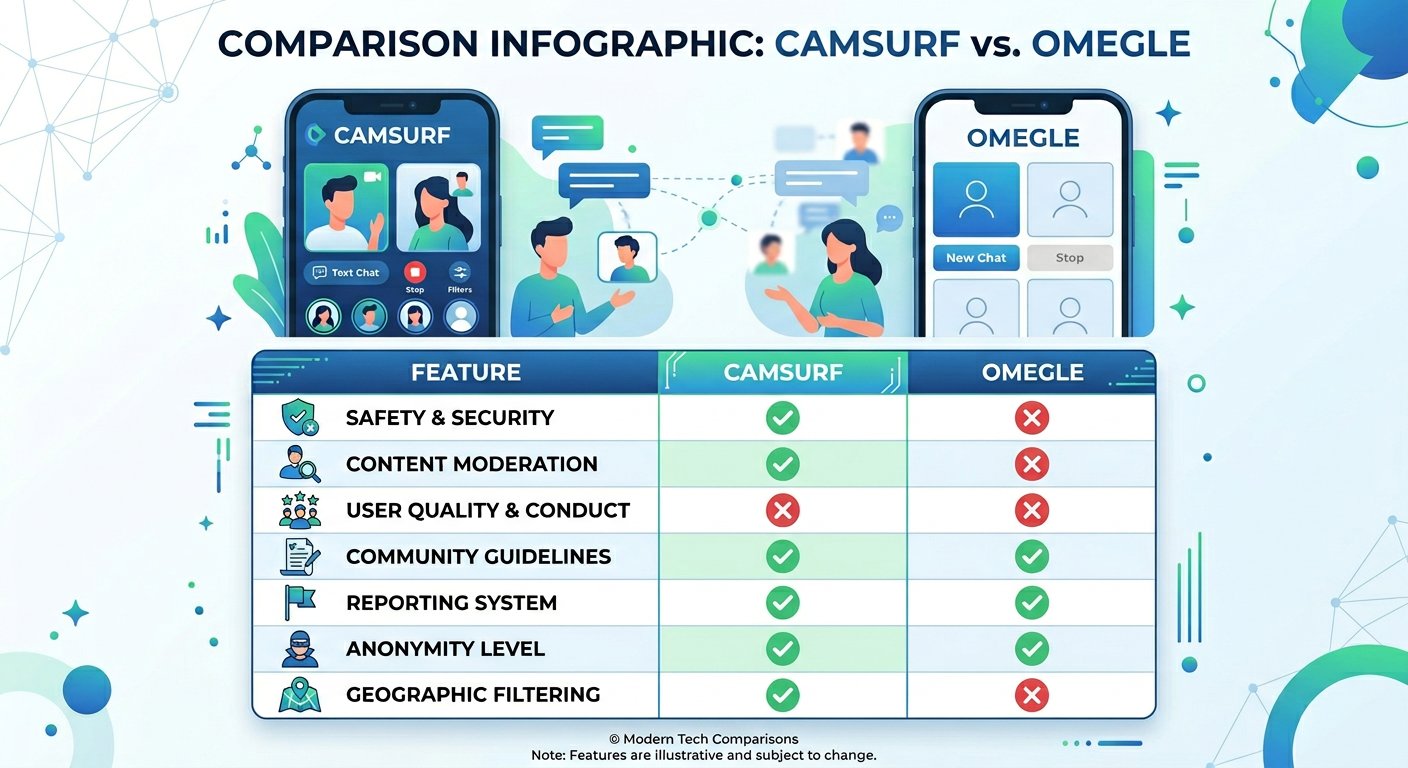
Winner for Safety: CamSurf — The dual-layer moderation system and device-level banning give CamSurf a significant advantage.
User Quality and Experience
User quality determines whether your time on these platforms feels worthwhile or frustrating.
Omegle attracted a broad user base over its 14 years of operation. This meant variety—you could find anyone from teenagers practicing languages to adults seeking explicit content. However, the lack of any filtering meant you never knew who you’d meet. The platform became increasingly associated with inappropriate behavior, which drove away many mainstream users.
CamSurf’s community tends to skew younger and more family-friendly. The active moderation creates a cleaner environment, though some users complain about stricter rules compared to other platforms. The language and region filters help you find people you can actually communicate with, which improves conversation quality significantly.
The gender filter is available in free form with some limitations, which helps users find the type of interactions they’re looking for—something Omegle never offered.
Winner for User Quality: CamSurf — Better moderation and filtering options lead to higher-quality interactions on average.
Matching Speed and Technology
Both platforms aim for quick connections, but the technology behind the scenes differs.
Omegle’s matching was essentially random—click chat, get paired with whoever happens to be online. This simplicity was part of its appeal, but it also meant long waits during off-peak hours and unpredictable match quality.
CamSurf uses a more sophisticated matching system that considers your language and region preferences. The system prioritizes active users, which reduces dead air time. Matching typically happens within seconds during peak hours.
Mobile apps are available for both iOS and Android on CamSurf, while Omegle never offered official mobile applications. For users who prefer chatting on their phones, CamSurf provides a native experience rather than relying on a mobile browser.
Winner for Matching Speed: CamSurf — Better infrastructure and preference-based matching lead to faster, more relevant connections.

Privacy and Data Practices
Privacy matters when you’re showing your face to strangers.
Omegle logged IP addresses and chat history, which became problematic when legal authorities started investigating the platform. The data retention practices made it possible to identify users, which undermined the anonymity the platform claimed to offer.
CamSurf requires no account creation, which means there’s no personal information tied to your usage. The platform doesn’t require email, phone number, or any identifying information. This anonymous-by-default approach protects user privacy better than Omegle’s logging practices.
For more details on how these platforms handle your data, Omegle safety history provides background on the privacy trade-offs that affected the platform’s operation.
If you’re concerned about privacy while using video chat platforms, our honest assessment of Omegle alternatives in 2026 covers additional privacy considerations.
Winner for Privacy: CamSurf — No accounts means no data to lose or misuse.

FAQ — CamSurf vs Omegle
Is CamSurf actually safer than Omegle was?
Yes. CamSurf’s dual-layer moderation system (AI + human review) combined with device-level banning creates a significantly safer environment than Omegle ever offered. Omegle’s shutdown in 2023 was largely due to its inability to handle safety issues effectively.
Can I still use Omegle?
No. Omegle shut down permanently in November 2023. The platform settled a $22 million lawsuit and closed all operations. You can explore alternatives like CamSurf, OmeTV, or other random chat platforms instead.
Does CamSurf require an account?
No. CamSurf allows anonymous access without registration. You can start chatting immediately after granting camera and microphone permissions.
What happened to all the Omegle users?
Many migrated to alternatives like CamSurf, OmeTV, Chatroulette, and other random chat platforms. Each platform has different strengths—CamSurf appeals to users seeking a cleaner, more moderated experience.
Is CamSurf completely safe?
No platform can guarantee complete safety for random video chat. However, CamSurf’s active moderation significantly reduces exposure to inappropriate content compared to unmoderated alternatives. Use standard online safety practices: don’t share personal information, report bad behavior, and exit conversations that make you uncomfortable.
What’s better for meeting people from specific countries?
CamSurf. Its language and region filters allow you to specify preferences before matching, while Omegle offered no filtering options. This makes CamSurf significantly better for international connections.